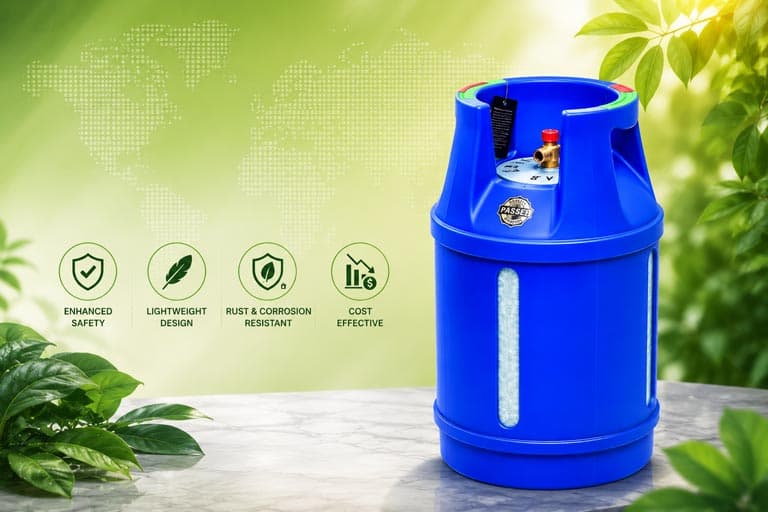
PSI, ISO, OGRA, EN — LPG cylinder certifications in Pakistan can be confusing. This guide explains exactly what PSI certification means, which Pakistani standard it corresponds to, what an ISO 11119-3 and EN 14427 certification covers, and how to verify a cylinder is genuinely certified.
Key Takeaways
- ✓"PSI certified" in the Pakistani LPG context typically refers to compliance with Pakistan Standard PS 4922 — the primary national safety standard for steel LPG cylinders
- ✓ISO 11119-3 and EN 14427-2022 are the international standards that govern composite LPG cylinders — these are accepted by OGRA as equivalent to or exceeding PS 4922
- ✓A genuine certification marking includes a certificate number, accredited laboratory name, and standard reference — not just a logo or sticker
- ✓Counterfeit certification markings are a known problem in Pakistan's LPG market — always buy from OGRA-licensed dealers to reduce the risk
- ✓WAA Technologies composite cylinders are individually certified to both ISO 11119-3 and EN 14427-2022 with traceable certificate numbers
Pakistani LPG cylinder shoppers and safety-conscious households frequently search for a "PSI certified gas cylinder in Pakistan." The search reflects genuine concern about cylinder safety — but also significant confusion about what certification actually means in the Pakistani context, which authority certifies what, and how to verify that a cylinder's certification claim is genuine rather than a sticker applied for marketing purposes. For the full picture of OGRA's cylinder compliance requirements, see the dedicated guide. This article clarifies the complete certification landscape for LPG cylinders in Pakistan.
What Does "PSI Certified" Mean for LPG Cylinders in Pakistan?
The term "PSI certified" is used colloquially in Pakistan to mean certification to a Pakistan Standard — a standard set by the Pakistan Standards and Quality Control Authority (PSQCA) and designated with the prefix "PS" followed by a number. For LPG cylinders specifically, the relevant Pakistan Standard is PS 4922 — the specification for seamless steel LPG cylinders for household use. A cylinder described as "PSI certified" or "PS certified" in the Pakistani market should carry an official PSQCA certification mark and reference to PS 4922 on its body.
However — and this is critical — PS 4922 only covers conventional steel cylinders. It does not cover composite (fibre) cylinders. For composite cylinders, PSQCA and OGRA currently accept international standards, primarily ISO 11119-3 and EN 14427-2022, as the applicable certification framework. This means that a composite cylinder described as "PSI certified" may not technically be certified to any PS standard — but if it carries ISO 11119-3 or EN 14427 certification from an accredited testing laboratory, it meets or exceeds the safety requirements that the PS system is intended to enforce.
Pakistan Standard PS 4922 — What It Covers
PS 4922 sets the minimum requirements for steel LPG cylinders manufactured for use in Pakistan. It covers: material specification (the minimum steel grade and thickness required for cylinder construction), welding requirements (the quality and testing requirements for cylinder seam welds), heat treatment after welding, dimensional tolerances, pressure testing requirements (burst test at 3× working pressure; hydrostatic test at 1.5× working pressure), valve fitting specifications, and mandatory markings. Cylinders that meet all PS 4922 requirements are eligible for PSQCA certification and can display the PS mark on their body.
PS 4922 does not cover: composite cylinders; performance in fire engulfment scenarios; long-term fatigue testing; UV resistance; or the specific valve and safety relief specifications now required under international composite cylinder standards. This is why PS 4922 compliance alone is not a sufficient safety benchmark for composite cylinders.
ISO 11119-3 — The International Standard for Composite Cylinders
ISO 11119-3 is the International Organization for Standardization standard specifically for refillable composite gas cylinders with load-bearing fibre-reinforced plastic construction and non-load-bearing metallic liners. This is the primary international standard under which WAA Technologies composite cylinders are certified. ISO 11119-3 certification requires:
- Burst testing — cylinder is pressurised to destruction; must withstand at least 2× its working pressure before failing, and failure mode must not be fragmentation (the cylinder must leak before it bursts)
- Cycle testing — cylinder undergoes 12,000 pressure fill-and-empty cycles at working pressure to simulate full service life without failure
- Fire engulfment testing — cylinder is exposed to sustained fire for a specified duration; must not fragment (controlled gas release is acceptable)
- Drop testing — cylinder is dropped from 1.8 metres in multiple orientations; must retain structural integrity and pass subsequent pressure testing
- UV degradation testing — cylinder is exposed to accelerated UV radiation equivalent to years of outdoor exposure; must retain rated structural properties
- Environmental conditioning — cylinder is subjected to simulated long-term outdoor exposure (temperature cycling, humidity) and must pass pressure testing after conditioning
Only cylinders that pass all ISO 11119-3 tests at an accredited testing laboratory receive certification. Each certified cylinder carries an individual serial number traceable to the testing record.
EN 14427:2022 — The European Standard
EN 14427:2022 (European Norm) is the European equivalent standard for transportable refillable composite cylinders for liquefied petroleum gas. It is in many respects equivalent to ISO 11119-3 but includes additional requirements specifically for LPG composite cylinders regarding valve compatibility, filling and dispensing procedures, and transport safety. WAA Technologies composite cylinders certified to EN 14427:2022 meet the most rigorous composite cylinder safety framework currently in use anywhere in the world. This certification is accepted by OGRA as satisfying commercial LPG cylinder safety requirements in Pakistan.
How to Verify a Cylinder's Certification Is Genuine
Counterfeit certification markings are a documented problem in Pakistan's LPG equipment market. Stickers, embossed logos, and even stamped markings can be applied to non-certified cylinders to simulate compliance. A genuine certification can be verified by checking:
- The certificate number — a genuine ISO or EN certification assigns a unique certificate number to the manufacturer and model. This number should be verifiable with the certifying laboratory.
- The certifying body name — a legitimate certification will name the accredited testing laboratory (e.g., a TÜV-certified lab, an SGS facility, or another ISO 17025-accredited body). A marking that just says "ISO 11119-3" without a certifying body name is unverifiable.
- The manufacturer name and cylinder serial number — each cylinder should have an individual serial number traceable to the manufacturer's production and certification records.
- Buy from an OGRA-licensed dealer — OGRA-licensed dealers are responsible for the compliance of products they sell. Purchasing from an authorised WAA Technologies dealer guarantees you receive a cylinder with genuine, traceable certification.
WAA Technologies Certification
WAA Technologies Pvt Ltd manufactures composite LPG cylinders in Gujranwala, Punjab, certified to both ISO 11119-3 and EN 14427:2022 at an internationally accredited testing facility. Each WAA cylinder carries its individual serial number, manufacture date, and certification reference permanently marked on the cylinder body. Certification documentation for the WAA cylinder range is available on request and is presented routinely during OGRA compliance inspections. Contact WAA Technologies at (+92) 4237815533 or visit waatechnologies.com for full certification documentation details.
Frequently Asked Questions About LPG Cylinder Certification in Pakistan
What is the difference between PS 4922 and ISO 11119-3 for LPG cylinders?
PS 4922 is Pakistan's national standard for steel LPG cylinders, covering construction, welding, and pressure testing. ISO 11119-3 is the international standard for composite (fibre) LPG cylinders, covering burst testing, fire engulfment, cycle testing, UV resistance, and drop testing. ISO 11119-3 is a more comprehensive safety standard than PS 4922, and OGRA accepts it as the compliance framework for composite cylinders in Pakistan.
How do I know if an LPG cylinder is genuinely certified in Pakistan?
Check the cylinder body for: a permanent marking (not a sticker) referencing the applicable standard (PS 4922 for steel, ISO 11119-3 or EN 14427 for composite); the name of the certifying body; the cylinder serial number; and manufacture date. Buy from an OGRA-licensed dealer who can provide documentation if asked. If any of these elements are missing, treat the certification claim with caution.
Is ISO 11119-3 or EN 14427 accepted by OGRA Pakistan?
Yes. OGRA currently accepts ISO 11119-3 and EN 14427 as the applicable international standards for composite LPG cylinders, in the absence of a specific Pakistani standard for composite cylinder construction. Composite cylinders certified to these international standards by accredited testing laboratories are legally marketable in Pakistan through OGRA-licensed distribution channels.
What should I do if I bought an LPG cylinder with no certification markings?
Stop using it. An LPG cylinder without identifiable certification markings cannot be verified for safety compliance. Contact your LPG dealer to report the cylinder and arrange a replacement from a certified manufacturer. For commercial premises, using uncertified LPG equipment creates legal liability under OGRA regulations and the Petroleum Act. If you purchased the cylinder from a dealer claiming it is certified, ask for written documentation — if they cannot provide it, report the dealer to OGRA.