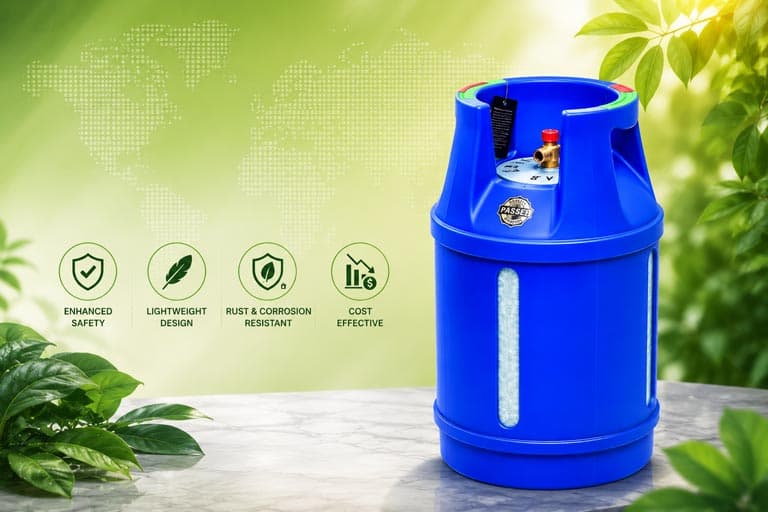
Pakistan's LPG industry is a PKR 600+ billion market serving 10 million households. This 2025 industry overview covers market size, growth drivers, key manufacturers, OGRA's role, the shift from steel to composite cylinders, and the investment opportunity in Pakistan's LPG transition.
Industry at a Glance (2025)
- ✓Pakistan LPG market size: estimated PKR 600–700 billion annually (upstream, midstream, and retail)
- ✓LPG consumers in Pakistan: approximately 10–12 million households, plus commercial and industrial users
- ✓Domestic LPG production: approximately 600,000 metric tons per year from OGDCL, PPL, and other E&P companies
- ✓LPG imports: Pakistan imports 60–70% of its consumption, primarily from Saudi Arabia, UAE, and Iraq
- ✓Composite cylinder adoption: currently less than 5% of Pakistan's cylinder fleet — representing the largest growth opportunity in the sector
Pakistan's LPG sector is one of the largest and most critical components of the country's energy infrastructure, yet it remains poorly understood by most stakeholders — including many of the households and businesses that depend on it daily. LPG provides cooking fuel for approximately 10–12 million Pakistani households, water and space heating for millions more, and industrial process heat for a significant portion of Pakistan's manufacturing sector. The industry generates hundreds of billions of rupees in annual revenue, employs hundreds of thousands of people across the value chain, and is managed under a regulatory framework governed by OGRA's LPG rules that is actively evolving as the sector transitions from an import-heavy, steel-cylinder dominated model toward a more efficient, safer composite cylinder infrastructure.
This industry overview provides a comprehensive picture of Pakistan's LPG market as of 2025 — its size, growth drivers, key players, supply chain, regulatory landscape, and the investment opportunity represented by the ongoing steel-to-composite cylinder transition. If you are considering that opportunity as a business, see our guide to becoming a WAA Technologies composite cylinder dealer.
Market Size and Structure
Pakistan's LPG market operates across three segments. The upstream segment covers LPG production (from domestic gas fields as a by-product of natural gas extraction) and import (from international LPG terminals and the spot market). The midstream segment covers storage, transportation, and wholesale distribution — LPG moves by pipeline, rail tanker, road tanker, and ship to storage terminals from which it is distributed to the downstream network. The downstream segment covers retail filling stations (where cylinders are refilled), retail dealers (who sell cylinders and gas to consumers), and the end consumers themselves: households, restaurants, hotels, industrial users, and vehicle LPG (autogas) users.
Combined across all three segments, the Pakistani LPG market has an estimated annual value of PKR 600–700 billion at 2025 LPG prices. This is a large industry — comparable in scale to several of Pakistan's major export industries — and one that is growing, driven by the continued expansion of LPG use into areas not served by the natural gas pipeline network.
Key Players in Pakistan's LPG Market
Upstream producers: OGDCL (Oil and Gas Development Company), PPL (Pakistan Petroleum Limited), and Mari Petroleum are Pakistan's largest domestic LPG producers. PSO (Pakistan State Oil), PARCO, and private sector importers handle LPG imports through the Port Qasim LPG terminal in Karachi and the Mahmood Kot fractionation plant in Punjab.
Distribution and retail: Over 200 OGRA-licensed LPG distributors operate across Pakistan, ranging from national-scale operations to city-level distributors. Shell Gas Pakistan, HASCOL Petroleum, Total Parco, and Burshane are among the better-known branded distributors. Thousands of OGRA-licensed retail dealers serve the household and commercial consumer base.
Cylinder manufacturers: The cylinder manufacturing segment is divided between conventional steel cylinder manufacturers (largely located in the industrial clusters of Karachi, Lahore, and Faisalabad) and the newer composite cylinder sector. WAA Technologies Pvt Ltd is Pakistan's leading domestic composite cylinder manufacturer, operating from Gujranwala with ISO 11119-3 and EN 14427-2022 certification. The composite sector is small but growing rapidly.
The Composite Cylinder Transition: Pakistan's Largest LPG Growth Opportunity
Pakistan's LPG cylinder fleet is estimated at 30–40 million active cylinders, with the vast majority being conventional steel. Composite cylinders represent less than 5% of the current fleet — but demand is growing at 25–35% annually as awareness of composite cylinders' safety and practical advantages increases and as the price premium over steel narrows due to manufacturing scale-up. The transition from steel to composite represents a capital replacement cycle worth billions of rupees in new cylinder purchases over the coming decade — and a corresponding reduction in Pakistan's annual gas cylinder blast incident toll.
Regulatory Evolution
OGRA is actively modernising Pakistan's LPG regulatory framework. Recent and ongoing regulatory developments include: tightening of hydrotest enforcement for steel cylinders; development of a composite cylinder-specific framework within the Pakistan Standard system (PS 4922 currently only covers steel); increasing commercial LPG premises inspection frequency; and pilot programs for digital cylinder tracking that would create a national registry of cylinder serial numbers, test dates, and fill histories. These regulatory developments all support the growth of certified composite cylinders at the expense of uncertified and non-compliant steel cylinder stock.
Frequently Asked Questions About Pakistan's LPG Industry
How large is Pakistan's LPG market?
Pakistan's LPG market has an estimated annual value of PKR 600–700 billion across upstream, midstream, and downstream segments at 2025 prices. The country consumes approximately 1.5–1.8 million metric tons of LPG annually, making it one of South Asia's largest LPG markets.
Who regulates LPG in Pakistan?
OGRA (Oil and Gas Regulatory Authority) is the federal regulator for all LPG activities in Pakistan, established under the OGRA Ordinance 2002 and operating under the Petroleum Act 1934. OGRA licenses upstream producers, importers, distributors, and retail dealers; sets safety standards; conducts market surveillance inspections; and manages the LPG pricing framework in coordination with the Ministry of Energy.
What is the growth outlook for Pakistan's composite LPG cylinder market?
Composite LPG cylinders represent the highest-growth segment of Pakistan's LPG equipment market. With a current fleet penetration below 5% against a 30–40 million total cylinder fleet, the addressable market for composite cylinder replacement is enormous. Growing consumer awareness of safety advantages, expanding authorised dealer networks, and increasing regulatory pressure on non-compliant steel cylinders all support continued rapid growth. WAA Technologies projects composite cylinder demand growing at 25–35% annually over the 2025–2030 period.
Where does Pakistan get its LPG?
Pakistan produces approximately 600,000 metric tons of LPG annually from domestic gas fields — primarily OGDCL and PPL operations in Sindh, Balochistan, and KPK. This covers approximately 30–40% of national consumption. The remaining 60–70% is imported, primarily from Saudi Arabia (via Saudi Aramco term contracts), the UAE, and Iraq. LPG is imported as liquefied gas by ship to the Port Qasim terminal in Karachi, then distributed by road and rail tanker to storage terminals across the country.