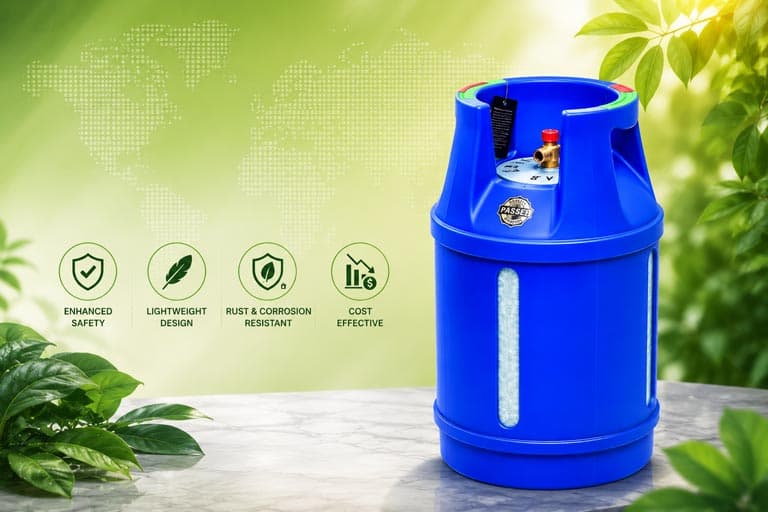
Pakistan faces recurring LPG shortages driven by supply chain bottlenecks and ageing infrastructure. Composite cylinders — lighter, more durable, and stackable — are a practical part of the solution every household can adopt today.
Key Takeaways
- ✓Pakistan imports 35–45% of its LPG demand — any supply disruption hits household stoves within weeks
- ✓Ageing steel cylinders leak an estimated 3–7% of distributed LPG before it reaches a stove
- ✓Composite cylinders carry 60–100% more gas per delivery trip due to half the weight of steel
- ✓A composite cylinder lasts 20+ years vs 8–12 for steel — the effective fleet size doubles over time
- ✓Every household that switches to composite improves the distribution system for the whole neighbourhood
Every year, as temperatures drop across Pakistan, the same painful scene plays out in cities from Lahore to Peshawar: long queues outside LPG dealers, frustrated households waiting days for a cylinder refill, and families forced back onto wood fires and kerosene stoves simply to cook a meal. The LPG gas shortage in Pakistan is not a new problem. It has repeated, deepened, and spread geographically for nearly two decades. Yet for all the government committees, regulatory announcements, and import diversification promises, the crisis returns every winter with the same ferocity — and it increasingly strikes during Ramadan and summer peaks as well.
The conventional framing of Pakistan's LPG shortage focuses on production deficits, import chain failures, and government policy — all real problems that genuinely need addressing. But buried within this crisis is a structural inefficiency that receives almost no public attention and that can be meaningfully improved right now, without waiting for government action or new import infrastructure: the ageing, heavy, corroding fleet of steel LPG cylinders that Pakistan's distribution system depends on. Replacing this fleet with modern composite LPG cylinders would not solve the shortage by itself — but it would substantially reduce its severity, improve distribution efficiency, extend cylinder lifespan, and directly reduce the LPG wastage that bleeds supply before it ever reaches a consumer's stove.
This article provides a complete, detailed examination of why Pakistan faces recurring LPG gas shortages, how the country's cylinder infrastructure actively worsens those shortages, and why composite cylinders — specifically WAATechnologies' ISO-certified composite cylinders manufactured in Gujranwala — represent the most practical, immediately available part of the solution.
What Is LPG and Why Is It Central to Pakistani Domestic Life?
Liquefied Petroleum Gas (LPG) is a mixture of propane and butane produced either as a by-product of natural gas processing or crude oil refining. When compressed and stored in a cylinder at moderate pressures, it liquefies — allowing a large volume of combustible energy to be stored in a portable, manageable container. When released through a regulator and burner, it vaporises and burns with a clean, high-temperature flame ideal for cooking, heating, and commercial food preparation.
In Pakistan, LPG plays a role that goes beyond a simple cooking fuel choice. Approximately 45–50% of Pakistani households are either not connected to the natural gas pipeline network or live in areas where pipeline pressure is consistently inadequate for cooking. For these households — concentrated in KPK, Balochistan, parts of interior Sindh, and Pakistan's vast peri-urban and rural fringes — LPG is the only practical modern cooking fuel available. It is cleaner than wood or charcoal (which remain common in areas without access to either pipeline gas or LPG), safer than kerosene, more convenient than coal, and far more efficient than biomass fuels that millions of Pakistani women still cook on daily.
LPG is also the primary cooking fuel backup for the tens of millions of households that do have pipeline gas connections but experience the recurring, severe winter shortages that make that connection functionally useless for hours or days at a time. For these households, LPG is the safety net that prevents the worst consequences of pipeline failure — and it is a safety net that fails during an LPG shortage precisely when it is needed most.
The Scale of Pakistan's LPG Gas Shortage: Understanding the Full Picture
Pakistan's LPG sector consumes approximately 1.2–1.5 million metric tons of LPG annually, a figure that has grown consistently at 8–12% per year as household penetration increases and commercial usage expands. Of this demand, domestic production from associated gas processing at fields operated by OGDCL, PPL, and Mari Petroleum covers roughly 55–65%. The remaining 35–45% must be imported — primarily from Saudi Arabia, UAE, and Qatar, arriving via Karachi port in pressurised LPG tankers and distributed through a network of bulk storage terminals, rail wagons, road tankers, and cylinder filling plants before reaching end consumers.
This import dependency is the first structural vulnerability. When global LPG prices spike — as they did dramatically in 2021–2022 during the post-COVID energy crisis and again with the Russia-Ukraine conflict disruptions — Pakistan's import capacity is constrained by both foreign exchange availability and Letters of Credit (LC) issuance by Pakistani banks. When the State Bank of Pakistan faces dollar reserve pressures and restricts LC issuance, LPG import volumes drop and shortages deepen domestically within 2–3 weeks. Pakistani consumers are thus exposed to global energy market volatility through a supply chain that provides minimal buffer stock between international disruption and domestic impact.
The second structural vulnerability is the distribution infrastructure itself. Pakistan's LPG distribution chain comprises approximately 180+ licensed LPG marketing companies, thousands of cylinder filling plants (many operating below international safety standards), and a retail dealer network of tens of thousands of outlets ranging from large modern facilities to informal roadside vendors. This fragmented, largely unmodernised distribution chain introduces inefficiency, wastage, and safety risk at every stage — and is heavily reliant on a cylinder fleet that is, in aggregate, ageing, corroding, and leaking.
Root Causes of the Recurring LPG Gas Shortage in Pakistan
Domestic Production Is Declining, Not Growing
Pakistan's natural gas fields — and the associated LPG produced from their processing — are in structural decline. Major fields like Sui, Qadirpur, and Kandhkot have been producing for decades and are past their peak output. New discoveries have not kept pace with depletion rates. OGDCL, the country's largest LPG producer, has seen its gas production volumes fall consistently. This declining domestic production means that the gap between what Pakistan produces and what it needs is widening every year — making the country progressively more dependent on imports, more exposed to import disruptions, and more vulnerable to foreign exchange constraints that limit import volumes.
Demand Is Growing Faster Than Supply Infrastructure
Pakistan's population growth, urbanisation, and expanding middle class are driving LPG demand higher every year. As more households transition from wood and biomass cooking to LPG — a transition encouraged by health awareness, convenience, and urban lifestyle change — the customer base expands. The number of LPG cylinder connections in Pakistan has grown significantly over the past decade, with particularly rapid growth in KPK, Balochistan, and peri-urban Punjab areas where pipeline gas is unavailable. This demand growth is positive from a development and health perspective — wood-burning cooking is a leading cause of indoor air pollution and chronic respiratory disease in Pakistani women — but it adds pressure to a supply chain that was already strained before the additional demand arrived.
Seasonal Demand Surges Overwhelm the System
LPG demand in Pakistan is deeply seasonal. Winter months — November through February — see demand surge 30–40% above summer baseline as households deploy LPG heaters, cooking duration increases with longer nights, and the social pattern of winter gatherings and richer cuisine preparation amplifies usage per household. The distribution system, sized for average annual demand, is structurally inadequate for peak winter demand. There is insufficient bulk storage capacity to carry forward summer production surpluses into winter, and insufficient distribution fleet capacity to accelerate deliveries when everyone needs refills simultaneously. The result is the annual winter LPG shortage that most Pakistani households have come to regard as an inevitable seasonal misery.
Ramadan adds a second, overlapping demand peak. Extended cooking hours for Sehri and Iftar, increased family gatherings, and the social obligation of generous food preparation all drive per-household LPG consumption significantly above normal during the holy month. When Ramadan falls in winter — as it does periodically — the two demand peaks combine and the shortage becomes acute.
The Import Chain Is Fragile and Slow to Respond
Pakistan's LPG import chain from production point to consumer cylinder involves a minimum of 6–8 weeks of lead time under normal conditions: tanker scheduling, loading at the source terminal, transit, Karachi port unloading (subject to congestion and berth availability), transfer to bulk storage, road transport to filling plants, cylinder filling, and final delivery. This long pipeline means that by the time an import disruption is identified, shortages are already developing in the downstream market. There is no mechanism for rapid supply response — a government decision to increase LPG imports today will not produce cylinders on dealer shelves for weeks. This lag makes the shortage, once started, self-reinforcing: dealers ration supply, consumers panic-buy and hoard, apparent demand spikes further, and the shortage deepens beyond what the underlying supply gap would suggest.
The Cylinder Fleet Problem: Pakistan's Most Overlooked Shortage Driver
Of all the factors driving Pakistan's LPG shortage, the ageing steel cylinder fleet is the one most rarely discussed in policy circles and media coverage — yet it may be the most addressable in the near term. Pakistan has millions of steel LPG cylinders in circulation. Many are old: corrosion-affected, past their mandated hydro-testing dates, with degraded valves and weakening body seams. OGRA mandates hydro-testing of LPG cylinders every five years, but regulatory enforcement across Pakistan's thousands of filling plants and hundreds of thousands of dealer outlets is inconsistent. A substantial proportion of cylinders in daily household use are beyond safe service life.
These ageing steel cylinders create four compounding problems during shortage conditions. First, they leak: corroded valves and weakened seams release LPG throughout the storage, transport, and retail chain, meaning that a significant proportion of the LPG that enters the distribution system never reaches a consumer's stove. Second, they fail and must be removed from service: when a cylinder rusts through or fails hydro-testing, it leaves the circulating fleet, reducing the total number of cylinders available for filling — directly reducing effective supply. Third, they are heavy: their weight limits how many can be transported per delivery trip, reducing distribution velocity. Fourth, they are inefficient to store: their cylindrical shape and instability when stacked mean they require far more floor space at filling plants and dealer premises than their gas content justifies, limiting the buffer stock dealers can maintain.
How Composite LPG Cylinders Directly Address Each Shortage Driver
Composite Cylinders Dramatically Improve Distribution Efficiency
A WAATechnologies composite LPG cylinder weighs 5.5–7 kg when empty. The steel equivalent weighs 15–17 kg. This 50–60% weight reduction has immediate, measurable implications for Pakistan's LPG distribution system. A delivery truck that currently carries 50 filled steel cylinders — limited by vehicle payload capacity — can carry 80–100 filled composite cylinders on the same trip, using the same fuel, driven by the same driver. This represents a 60–100% increase in delivery capacity per vehicle per day without any additional capital investment in trucks, drivers, or fuel.
Pakistan's LPG distribution fleet makes hundreds of thousands of delivery runs annually. If the cylinder fleet were predominantly composite, each of those runs would deliver significantly more gas to consumers. During a shortage, when every additional cylinder delivered matters enormously, this distribution efficiency gain would directly reduce the depth and duration of shortage conditions that Pakistani households experience. It would mean shorter queues at dealers, faster refill turnaround, and more households served per day during the critical peak shortage periods.
A 20+ Year Service Life Stabilises the Available Fleet
Steel cylinders in Pakistan's operating conditions — humidity, coastal salt air, temperature extremes, the rough handling of high-volume distribution operations — realistically last 8–12 years before corrosion forces retirement. WAA composite cylinders, manufactured to ISO 11119-3 and EN 14427-2022 international standards, are rated for 20+ years of service life with approximately 12,000 pressure cycles. This is not a manufacturer claim without basis — it is a consequence of the materials: HDPE and fiberglass do not corrode, fatigue in the same way as steel under pressure cycling, or degrade from UV or moisture exposure the way metal does.
The implications for Pakistan's cylinder fleet arithmetic are significant. If the national fleet were composite with a 20-year service life versus the current 10-year steel average, the same manufacturing investment would produce twice the cylinder-years of service. The effective size of the fleet available for filling and distribution would double over time — without any increase in manufacturing output. This fleet stability effect is slow but cumulative and represents one of the most powerful long-term benefits of composite cylinder adoption for Pakistan's LPG supply security.
Zero Corrosion Eliminates the Largest Source of Premature Fleet Loss
The HDPE liner and glass fibre composite outer construction of WAA cylinders cannot corrode. There is no iron in their construction to oxidise; no welds or seams where moisture can penetrate and initiate corrosion from the inside; no exposed metal surface where salt air, rain, or kitchen humidity can cause rust. A WAA composite cylinder stored in Karachi's coastal humidity for 20 years will emerge with its structural integrity entirely intact. A steel cylinder in the same environment will be heavily rusted within 5–8 years and removed from service within 10.
For Pakistan's LPG sector, this zero-corrosion property eliminates the most common cause of premature cylinder retirement. Every cylinder that reaches its full 20-year service life instead of being retired at year 10 due to corrosion is a cylinder that remains in the fleet, continues to be filled and delivered, and continues to supply a household that would otherwise be without a cylinder. Scaled across the millions of cylinders in Pakistan's national fleet, the fleet preservation impact of switching to composite is substantial.
Leak-Proof Design Converts Wastage into Supply
The jointless construction of WAA composite cylinders — no body welds, no seam joints, no metal-to-metal corrosion interfaces — produces a cylinder that is fundamentally more resistant to gas leakage than welded steel. Industry estimates of LPG wastage through the distribution chain — from leaking valves, deteriorated seals, and corroded body seams on steel cylinders — range from 3% to 7% of total distributed volume. In a market consuming over 1 million metric tons of LPG annually, even a conservative 3% wastage rate represents 30,000 metric tons of LPG per year that is imported, transported, paid for, and then escapes into the atmosphere without cooking a single meal.
Reducing this wastage through composite cylinder adoption is functionally equivalent to increasing supply. If wastage can be reduced from 5% to 1% of the distributed volume through the adoption of leak-resistant composite cylinders, Pakistan would effectively gain the equivalent of 4% more LPG supply without importing a single additional kilogram. At the household level, this means every cylinder delivered contains and delivers more gas to the stove rather than leaking away in storage — extending the effective cooking life of each fill.
Stackable Design Multiplies Buffer Stock Capacity at Every Node
Composite cylinders are manufactured with flat bases, consistent geometry, and structural reinforcement that permits safe vertical stacking. Steel cylinders, being round-bodied and bottom-heavy, are unstable when stacked and typically stored laid flat in single layers — consuming enormous amounts of floor space relative to the gas they contain. At a dealer premises that can currently store 100 steel cylinders laid flat, an equivalent composite cylinder stock stored vertically in a safe stack could represent 150–200 cylinders in the same footprint.
This increased storage density has a direct impact on shortage resilience. A dealer who can maintain a larger buffer stock of full cylinders absorbs supply disruptions without running out — providing continuity of supply to their customers during the days or weeks it takes for a supply disruption to be resolved. Across Pakistan's dealer network, greater stackability and higher buffer stock capacity mean the entire distribution system has more built-in resilience against the kinds of supply disruptions that currently turn a supply gap into a full shortage within 48–72 hours.
The Economic Case: Why Composite Cylinders Make Financial Sense for Pakistan
Pakistan's LPG import bill is a meaningful foreign exchange burden, denominated in US dollars at a time when Pakistan's dollar reserves have been under severe pressure. Any reduction in the volume of LPG that needs to be imported — whether through reduced wastage, improved efficiency, or better fleet management — directly reduces the foreign exchange demand associated with LPG imports. If composite cylinder adoption could reduce supply chain LPG wastage by even 2–3%, the import saving in dollar terms would run to hundreds of millions of rupees annually at current import prices.
At the consumer level, composite cylinders have a higher upfront purchase price than steel equivalents. However, their 20+ year service life versus 8–12 years for steel means the total cost of ownership across the full service life is comparable or lower. A household that purchases a composite cylinder and uses it for 20 years has effectively paid for 1.5–2 steel cylinders over the same period — with the composite option delivering superior safety, convenience, and reliability throughout. For households managing tight budgets, the higher upfront cost is a real barrier — but the long-term economics strongly favour composite.
Which Pakistani Regions Suffer Most — and How Composite Cylinders Help Each
Punjab (especially Lahore, Faisalabad, Multan): The most populous province is also the most severe shortage zone. High population density, the largest number of LPG-dependent households, and distance from import infrastructure combine to create the deepest shortages. Distribution efficiency gains from composite cylinders — more deliveries per truck per day — would have their largest impact here, where distribution bottlenecks are most severe.
Khyber Pakhtunkhwa: KPK has limited pipeline gas coverage outside major urban centres and colder winters that drive higher heating demand. LPG shortage duration in KPK is among the longest in the country. Fleet longevity gains from composite cylinders — fewer cylinders removed from service due to corrosion — would be particularly valuable in KPK's harsher climate, where steel corrosion accelerates.
Balochistan: Pakistan's largest province by area and most geographically isolated from import infrastructure. Mobile filling units cover enormous distances with limited loads. The weight reduction of composite cylinders — more cylinders carried per mobile unit trip — would directly increase the number of households served per route in Balochistan, where delivery logistics are the binding constraint on supply.
Interior Sindh: High humidity and flooding risk accelerate steel corrosion dramatically in interior Sindh. Composite cylinder's zero-corrosion property is most valuable in flood-prone regions where steel cylinders regularly suffer water damage that renders them unserviceable.
Practical Action Plan: What Every Pakistani Household Should Do Now
While Pakistan's government, OGRA, and LPG marketing companies work on long-term supply chain improvements, individual households can take concrete steps today to reduce their vulnerability to LPG shortages — and contribute to the systemic efficiency improvement that composite cylinder adoption represents:
- Switch from steel to a WAA composite cylinder: This is the single most impactful step. Every household that makes this switch reduces its own shortage vulnerability and improves the efficiency of the distribution system that serves the broader community
- Keep two cylinders as standard practice: Composite cylinders weigh half as much as steel, making the two-cylinder household approach practical for the first time. Two composite cylinders weigh less than one filled steel cylinder. Keeping a full spare means shortage periods become a mild inconvenience rather than a household crisis
- Use the see-through body to monitor levels proactively: WAA composite cylinders have a translucent HDPE body that lets you see the LPG level at any time. Reorder when the cylinder reaches one-quarter — not when it empties. Proactive reordering prevents the last-minute panic that amplifies dealer queue pressure during shortages
- Purchase only through authorised WAA dealers: The grey market for LPG cylinders — particularly uncertified or out-of-service steel cylinders sold informally — is a safety risk and contributes to the distribution system's inefficiency. WAA authorised dealers stock individually certified, hydro-tested composite cylinders with full traceability
- Build a relationship with your local dealer before the shortage hits: Dealers prioritise regular, known customers during shortage rationing. Establishing yourself as a consistent customer before winter or Ramadan provides meaningful supply priority when everyone else is queuing
- Store cylinders correctly to maximise service life: Store upright, in a ventilated area, away from direct sunlight and heat sources. Correct storage maximises cylinder service life and keeps it safe throughout its use period
What OGRA and the Industry Are Doing — and Why It Is Not Enough Alone
The Oil and Gas Regulatory Authority (OGRA) has taken a number of steps to address Pakistan's LPG shortage. These include licensing new LPG import terminals, encouraging investment in additional bulk storage capacity (AIVs and mounded bullets), implementing cylinder hydro-testing enforcement programmes, and working with the Ministry of Energy on import diversification from Central Asian suppliers. The Pakistan LPG distributors' association has similarly lobbied for more consistent import LC availability and faster port clearance for LPG tankers.
These are meaningful initiatives, and progress on each of them would genuinely improve Pakistan's LPG supply security. However, they are multi-year projects — new import terminals take 3–5 years to construct and commission; storage expansion requires capital investment and regulatory approvals; import diversification requires new logistics infrastructure and long-term supply agreements. None of these initiatives will materially ease the shortage that Pakistan's households face in the coming months. Composite cylinder adoption, by contrast, can begin today — any household that purchases a WAA composite cylinder immediately gains the benefits of improved distribution efficiency, better supply monitoring, and reduced shortage vulnerability.
Frequently Asked Questions About LPG Shortages and Composite Cylinders
Why does the LPG shortage hit some areas worse than others in Pakistan?
LPG shortage severity depends on distance from import infrastructure (Karachi port and filling plants), population density, local demand-to-supply ratios, and the efficiency of local distribution fleets. Punjab's combination of high density and distance from import points makes it the worst-affected region. Rural areas with infrequent delivery visits suffer longer duration shortages even if individual delivery quantities are adequate when they arrive.
Do composite cylinders work with my existing gas stove and regulator?
WAATechnologies composite cylinders use standard LPG valve configurations compatible with most domestic gas stoves and regulators used in Pakistan. WAA also supplies matched high-quality regulators designed specifically for their cylinder valve design, which we recommend for optimal performance and safety. A qualified gas technician can verify compatibility with your specific stove setup in a few minutes.
Is the higher price of a composite cylinder worth it during a shortage?
Yes, for multiple reasons. A composite cylinder's 20+ year service life means the higher upfront price is spread over twice the service period of a steel cylinder — making the per-year cost comparable. More importantly during shortage conditions, the ability to keep a second cylinder as a backup (practical because of the weight reduction) provides supply security that has enormous household value during an acute shortage. The peace of mind of knowing you have a full backup cylinder while the dealer queue stretches around the block is difficult to quantify but profoundly real.
Can I use an LPG composite cylinder for heating as well as cooking?
Yes. Composite LPG cylinders are compatible with LPG room heaters and water heaters, in addition to cooking stoves. Gas heaters consume LPG at significantly higher rates than cooking stoves, so a household using one cylinder for both cooking and heating will need to increase their buffer stock accordingly. A 12 kg composite cylinder used for combined cooking and heating in a Pakistani winter may last 2–3 weeks rather than the 5–6 weeks typical for cooking-only use.
Where can I find a WAATechnologies authorised dealer near me?
WAATechnologies operates an authorised dealer network across Punjab, Sindh, and KPK. Contact WAATechnologies directly at (+92) 4237815533 to locate your nearest authorised dealer. Always purchase composite cylinders through authorised channels to ensure you receive a genuine, certified, and warranted product.
Conclusion: The Most Practical Solution Available Today
Pakistan's LPG gas shortage is the product of multiple compounding factors — declining domestic production, fragile import chains, explosive demand growth, and an ageing distribution infrastructure held together by a cylinder fleet that is past its best. Solving this problem comprehensively requires years of infrastructure investment, regulatory reform, and import diversification. But one component of the solution is available today, to every Pakistani household and to every LPG distributor in the country: replacing conventional steel cylinders with modern composite LPG cylinders that deliver more gas per delivery trip, last twice as long, never corrode, and waste less LPG throughout the distribution chain.
WAATechnologies Pvt Ltd manufactures composite LPG cylinders to ISO 11119-3 and EN 14427-2022 international standards at their Gujranwala facility. Every cylinder is individually hydro-tested and certified before leaving the factory. With an authorised dealer network across Punjab, Sindh, and KPK, WAA composite cylinders are available nationwide. Every household that makes the switch is not just solving their own shortage problem — they are contributing to a distribution system that works better for everyone. That is a rare opportunity to do well and good simultaneously, and it is available starting today.
Contact WAATechnologies at (+92) 4237815533 or visit our showroom at 172-A First Floor, Adjacent Bahria Grand Masjid, Sector E Commercial Bahria Town Lahore. Visit our online shop to order your composite cylinder and take control of your household's LPG supply security.