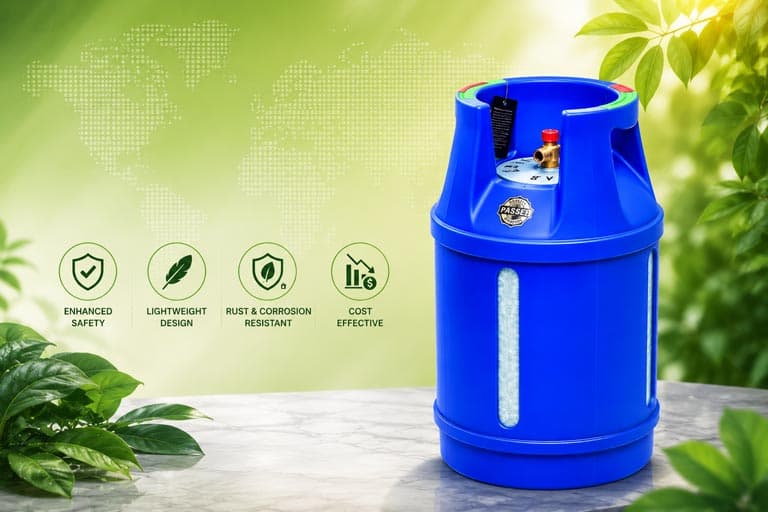
Before an LPG cylinder reaches your kitchen, it undergoes rigorous safety testing. This guide explains the complete certification process — burst testing, cycle testing, UV testing, drop testing — and what ISO 11119-3 and EN 14427-2022 certification actually certifies.
Key Takeaways
- ✓LPG cylinder certification requires passing a series of independent laboratory tests — not just manufacturer self-declaration
- ✓ISO 11119-3 composite cylinder certification includes burst testing, 12,000-cycle fatigue testing, fire engulfment, drop testing, and UV degradation
- ✓The fire engulfment test is the most important safety test — it confirms a composite cylinder will not rupture and fragment under sustained fire exposure
- ✓Steel cylinders (PS 4922) must pass hydrostatic burst testing and periodic hydrotest every 5 years
- ✓Every WAA Technologies cylinder carries individual test traceability — the certificate number links each cylinder to its specific testing record
When a Pakistani household purchases an LPG cylinder, the markings on the cylinder body represent the conclusion of an extensive safety testing process that the cylinder design has been through before a single unit was manufactured for sale. That process — independent laboratory testing, documented in a certification record traceable to every cylinder sold — is the basis of the safety claim that a manufacturer makes when they stamp ISO 11119-3 or PS 4922 on the cylinder. To understand how these certifications relate to composite LPG cylinder safety in practice, see the dedicated safety guide. This article explains what the testing actually involves, test by test, and why understanding it helps Pakistani consumers make better-informed cylinder purchase decisions.
How Cylinder Certification Works
LPG cylinder certification is a two-level process. At the design certification level, the cylinder manufacturer submits representative prototype cylinders to an accredited, independent testing laboratory — a facility with ISO 17025 accreditation covering pressure vessel testing. The laboratory conducts the full test series (described below) on the prototype cylinders. If all tests are passed, the laboratory issues a design certificate to the manufacturer, authorising them to manufacture and sell that specific cylinder model under the certified standard. The design certificate references the cylinder model, the applicable standard, the test dates, and the certificate number.
At the production quality level, the manufacturer maintains quality control processes (inspections, sample testing, dimensional verification) ensuring that every cylinder produced matches the certified design. OGRA and PSQCA oversight adds a regulatory layer to this production quality monitoring. Each individual cylinder receives its serial number, manufacture date, and certification reference during production — creating the traceability that links each physical cylinder back to the design certification record.
The ISO 11119-3 Test Series for Composite Cylinders
Burst Test
The burst test pressurises the cylinder with water to its failure point. ISO 11119-3 requires the cylinder to withstand at least twice its rated working pressure before any failure occurs. Crucially, the failure mode must be a gas leak (a fracture that opens progressively without fragmentation) — not a brittle rupture that fragments the cylinder. This test directly validates the "non-blast" claim: the composite cylinder must leak before it bursts, and the failure must not generate dangerous fragments. Cylinders that burst below twice working pressure or that fragment during the burst test fail certification.
Cycle Test (12,000 Pressure Cycles)
The cycle test simulates the full service life of the cylinder through accelerated fatigue cycling. The cylinder is pressurised to its working pressure and then depressurised, repeatedly — 12,000 times. This simulates 12,000 fill-and-empty cycles, equivalent to over 20 years of household LPG use at typical refill frequencies. After all 12,000 cycles, the cylinder is burst-tested again. It must still pass the burst test requirements — confirming that the composite construction does not degrade in strength over its rated service life. Cylinders that develop leaks during cycling, or that fail the post-cycle burst test, fail certification.
Fire Engulfment Test
The fire engulfment test is the most safety-critical and dramatically demonstrative test in the series. A filled cylinder is exposed to a sustained open flame — fire applied around the full circumference of the cylinder — for a specified duration. The test measures the time to first pressure relief valve actuation (or first gas release) and confirms that the cylinder does not fragment. The required outcome for certification is pressure relief through the valve or a controlled gas leak without catastrophic rupture. A steel cylinder without a functioning pressure relief valve would rupture violently under this test. The composite cylinder must demonstrate the non-blast behaviour that is its primary safety advantage — releasing pressure gradually as gas, not explosively as shrapnel.
Drop Test
The drop test evaluates mechanical damage resistance. Cylinders are dropped from a height of 1.8 metres onto a concrete surface in multiple orientations — upright, inverted, and on their side. After each drop orientation, the cylinder is inspected for structural damage and then subjected to pressure testing. Cylinders must retain their structural integrity and pass pressure testing after all drop orientations. This test simulates the handling accidents that occur in Pakistan's rough LPG distribution chain — cylinders falling from truck beds, being dropped at dealer premises, being knocked over in kitchens.
UV Degradation Test
The UV degradation test exposes the cylinder body to accelerated ultraviolet radiation equivalent to several years of outdoor sun exposure. After UV exposure, the cylinder is retested for mechanical properties. The HDPE body and fibre winding materials must retain their rated strength after UV aging. This test is particularly relevant for Pakistani conditions, where cylinders are frequently stored outdoors in high-UV sunshine environments and where UV-stabiliser quality in cheaper imported composite cylinders is variable.
Environmental Conditioning
Cylinders are subjected to simulated environmental aging: temperature cycling (extreme hot and cold in sequence), high humidity exposure, and salt spray (simulating coastal environments like Karachi). After conditioning, cylinders must pass pressure testing. This confirms that the composite materials maintain their properties across the full range of conditions they will encounter in Pakistan.
Steel Cylinder Testing: PS 4922 Hydrostatic Test
Steel cylinders are tested to Pakistan Standard PS 4922, which requires a hydrostatic burst test at manufacture (1.5× working pressure) and a periodic hydrotest every 5 years in service. The hydrotest fills the cylinder with water and pressurises it to 1.5× working pressure, checking for leaks, permanent deformation, and structural integrity. Cylinders that leak, deform, or fail to reach test pressure fail the hydrotest and must be decommissioned.
Critically, steel cylinder PS 4922 testing does not include a fire engulfment test. The non-blast behaviour that composite cylinders are required to demonstrate for ISO 11119-3 certification is not tested for steel cylinders under Pakistani certification requirements. This is the regulatory gap that makes steel cylinders capable of a violent BLEVE under fire conditions while composite cylinders are not.
Frequently Asked Questions About LPG Cylinder Safety Testing
What does the fire engulfment test prove about composite cylinders?
The fire engulfment test proves that under sustained fire exposure, an ISO 11119-3 certified composite cylinder releases pressure through a controlled gas leak rather than a violent rupture. It is the specific test that validates the "non-blast" claim made for composite cylinders. Every WAA Technologies composite cylinder model has passed the fire engulfment test as part of its ISO 11119-3 certification — meaning the non-blast property is a tested and certified reality, not a manufacturer claim.
What is the difference between the hydrotest and the burst test?
The hydrotest (1.5× working pressure with water) checks that a specific cylinder in service is still structurally sound after years of use — it is a periodic in-service inspection tool. The burst test (pressurised to failure, minimum 2× working pressure) is a design qualification test that validates the cylinder's design safety margin and failure mode. The burst test is done once during design certification; the hydrotest is repeated every 5 years in service for steel cylinders.
How do I know if a WAA Technologies cylinder has been genuinely tested?
Every WAA Technologies composite cylinder carries its individual serial number on the cylinder body. This serial number is traceable to WAA's production records and the specific certification testing batch. WAA Technologies can provide certification documentation on request — including the certificate number, certifying laboratory name, and test dates — for any cylinder identified by serial number. Contact WAA Technologies at (+92) 42 37815533 for certification documentation requests.
Are older steel cylinders retested every 5 years in Pakistan?
OGRA requires hydrotesting every 5 years, but enforcement at the retail filling level is inconsistent. Many Pakistani households continue using steel cylinders that are long overdue for hydrotesting because informal dealers refill cylinders without checking test dates. This is a significant safety gap. A cylinder that fails the hydrotest — structurally compromised by corrosion or fatigue — should be decommissioned but instead remains in circulation. Switching to a certified composite cylinder eliminates this risk category entirely.