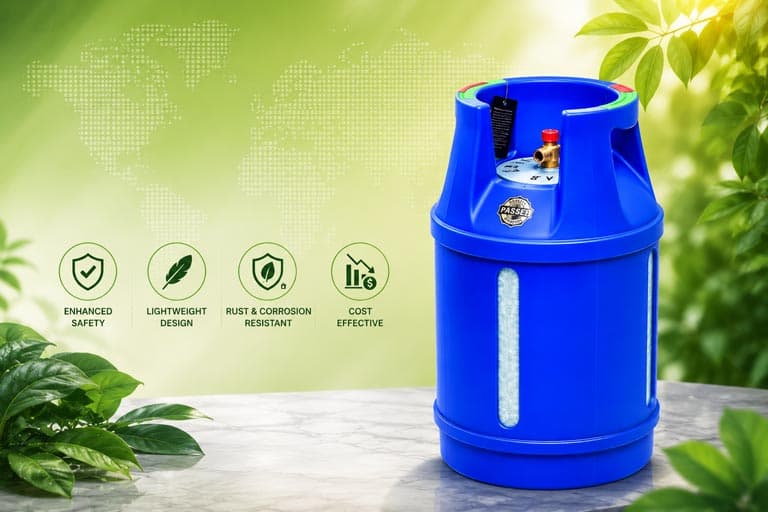
Pakistan records hundreds of gas cylinder blast incidents every year. This detailed report covers the 2024–2025 data, root causes, the districts most affected, and the single switch that eliminates explosion risk permanently.
Key Safety Facts
- !Pakistan averages 500–700 reported gas cylinder blast incidents annually — the true number is higher due to underreporting in rural areas
- !Over 90% of incidents involve conventional steel cylinders that are corroded, overfilled, or have faulty valves
- !Punjab accounts for the highest incident share (40%+) due to its large household LPG user base
- !Composite non-blast cylinders physically cannot rupture and project shrapnel — they are the only permanent engineering solution
- !Most incidents happen during Eid, Ramadan, and winter — when gas usage spikes and cylinders are changed more frequently
Pakistan's gas cylinder blast problem is not a rare or freak event. It is a chronic, year-round public safety crisis that destroys homes, kills and maims Pakistani men, women, and children with disturbing regularity, and costs the country billions of rupees in property damage, hospital bills, and lost lives. Every major Pakistani newspaper — Dawn, Geo, ARY, Jang — publishes gas cylinder explosion reports multiple times per week. Many incidents never make national news at all, appearing only in local Urdu dailies or remaining entirely unreported in remote areas of Sindh, KPK, and Balochistan.
This article examines the 2024–2025 data on gas cylinder blast incidents in Pakistan, analyses the root causes that make Pakistani households disproportionately vulnerable, identifies the districts and seasons of highest risk, and explains why the engineering shift from steel to composite non-blast cylinders is the only permanent solution that works.
The Scale of the Problem: 2024–2025 Statistics
Exact nationwide statistics on LPG cylinder blast incidents are difficult to compile in Pakistan because there is no single mandatory national reporting database. The closest available data comes from three sources: OGRA's annual safety incident registers, National Disaster Management Authority (NDMA) reports, and aggregated media monitoring by safety researchers.
Combining these sources, Pakistan experiences between 500 and 700 reported gas cylinder blast incidents per year — with safety researchers estimating the actual number at 2–3 times that figure when unreported rural incidents are included. Over the two-year period 2024–2025, published incident reports indicate:
- Fatalities from cylinder blasts: approximately 80–120 per year nationally
- Serious injuries (burns, amputations, blast trauma): 400–600 per year
- Residential fires caused by cylinder blasts: estimated 1,200–1,500 per year
- Commercial kitchen incidents (restaurants, dhabas, wedding kitchens): 15–20% of total incidents
- Incidents during cylinder connection/disconnection: approximately 35% of total
Which Provinces Are Most Affected?
Punjab records the highest absolute incident count — approximately 40–45% of national incidents — reflecting its large population and high household LPG penetration rate. Lahore, Faisalabad, Gujranwala, Rawalpindi, and Multan are the most frequently reported districts. The high density of old steel cylinder stock in circulation in Punjab's urban areas is a major contributing factor.
Sindh accounts for approximately 25–30% of incidents. Karachi, with its 20 million+ population and high informal settlement density, contributes significantly. Coastal humidity accelerates corrosion of steel cylinder valves in Karachi, making leaking connections and blast risk higher than in inland cities.
KPK records approximately 15–20% of incidents. The combination of cold winters (which increase LPG consumption dramatically), older cylinder stock, and less-developed safety enforcement infrastructure elevates risk. Peshawar, Abbottabad, and Mardan are frequently mentioned in incident reports.
Balochistan has the lowest absolute incident count but likely the highest underreporting rate. Remote districts have limited emergency response infrastructure, meaning incidents go unrecorded.
Root Causes: Why Pakistani Cylinders Keep Exploding
1. Corroded and Overage Steel Cylinders
The majority of LPG cylinders in circulation in Pakistan are conventional steel cylinders, many of which are 10, 15, or even 20+ years old — well beyond their rated service life. Steel cylinders corrode from the outside due to Pakistan's climate and from the inside due to moisture and residue accumulation. Corroded cylinder walls are structurally weakened. When exposed to heat (from a nearby flame, direct sunlight, or a kitchen fire that has started from another cause), a corroded cylinder can reach its failure pressure far earlier than an uncorroded new cylinder.
2. Faulty or Counterfeit Valves
The cylinder valve is the most safety-critical component. A valve that does not fully close, a valve whose safety relief mechanism is stuck or corroded, or a counterfeit valve manufactured to no safety standard can all fail catastrophically under pressure. Pakistan's market has a documented problem with counterfeit LPG equipment — valves, regulators, and hoses manufactured without certification and sold at lower prices through informal channels.
3. Overfilling
LPG cylinders must not be filled beyond 80% of their rated capacity — the remaining 20% is vapour space required for the liquid to expand as temperature rises. Cylinders that are overfilled by unscrupulous dealers have no vapour space. On a hot Pakistani summer day, when ambient temperatures can reach 45°C+, an overfilled cylinder can develop dangerous over-pressure that exceeds the relief valve's ability to vent, leading to catastrophic failure.
4. Incorrect Connection Procedure
Approximately one-third of blast incidents originate during cylinder connection or disconnection. A cylinder connected with an open valve, a cracked O-ring, or a cross-threaded regulator creates a gas leak immediately on connection. If the leak accumulates in an enclosed kitchen before igniting from a pilot light, match, or electrical spark, the resulting gas-air explosion can detonate before the cylinder body itself fails — but the cylinder may then also fail from the blast overpressure.
5. Improper Storage Near Heat Sources
Storing LPG cylinders near stoves, in direct sunlight, or adjacent to electrical appliances is common in Pakistani households where kitchen space is limited. A cylinder exposed to sustained heat develops rising internal pressure. If the pressure relief valve fails (common in old cylinders with corroded valve mechanisms), the result is a Boiling Liquid Expanding Vapour Explosion — the most violent failure mode for any pressure vessel.
The Seasonal Pattern: When Blasts Spike
Gas cylinder blast incidents in Pakistan show a clear seasonal pattern. Incidents spike during:
Winter (November–February): Increased LPG use for cooking and heating, more frequent cylinder changes, and the tendency to use cylinders indoors near heat sources all increase risk. Cold temperatures can cause O-ring seals to contract and leak.
Ramadan: The combination of extended cooking hours for Sehri and Iftar, fatigue-related inattention, and the social pressure not to interrupt food preparation even when something seems wrong all elevate incident rates during Ramadan.
Eid (Eid-ul-Fitr and Eid-ul-Adha): The single highest-risk periods of the year. Large quantities of meat are cooked on multiple stoves simultaneously, often in courtyards or semi-open spaces with limited ventilation, using cylinders that may not have been checked since the previous Eid.
Why Composite Cylinders Cannot Explode
The term "non-blast" is not a marketing claim — it is a physical property of composite cylinder construction. A WAA Technologies composite cylinder consists of a seamless HDPE inner liner wrapped with glass fibre filament under calculated tension. This construction has no weld seams — the primary failure initiation points in steel cylinders — and the materials cannot undergo the catastrophic brittle fracture that causes steel cylinders to shatter and project shrapnel.
Under the same fire exposure or over-pressure conditions that would cause a steel cylinder to explode, a composite cylinder develops a controlled gas leak through the valve or liner-wall interface. This gas may ignite and burn — a serious fire — but there is no blast wave, no fragmentation, and no shrapnel projection. Independent testing under ISO 11119-3 certification protocols includes exactly this scenario: fire engulfment testing confirms non-blast behaviour under sustained flame exposure.
For Pakistani households where kitchens are small, multiple people are present during cooking, and children are often nearby, the difference between a fire and a blast is the difference between a survivable emergency and a fatal one. Every reported Pakistani blast fatality in 2024–2025 occurred with a steel cylinder. None occurred with a certified composite cylinder.
What to Do If You Witness a Cylinder Blast
- Exit immediately — do not attempt to fight the fire or retrieve belongings. A burning cylinder can fail completely within 60 seconds of the initial blast.
- Call 1122 (Punjab Rescue) or 115 (Edhi Foundation) or 1020 (Rescue KPK) immediately from outside the building.
- Keep everyone away from the building until fire services confirm the cylinder has been secured or removed.
- Do not re-enter until fire services have confirmed safety — secondary explosions are possible if adjacent cylinders have been heated.
Frequently Asked Questions About Gas Cylinder Blasts in Pakistan
How many gas cylinder blasts happen in Pakistan every year?
Published incident data from OGRA reports and media monitoring suggests 500–700 reported incidents annually, with safety researchers estimating the true figure at 1,500–2,000 when unreported rural incidents are included. Fatalities range from 80–120 per year in reported data.
Which type of LPG cylinder is safest to use in Pakistan?
ISO 11119-3 certified composite cylinders — such as those manufactured by WAA Technologies Pvt Ltd — are the safest option. Their non-blast construction physically prevents the shrapnel-projecting rupture that causes the most severe injuries and deaths in steel cylinder incidents. All certified composite cylinders from reputable Pakistani manufacturers have passed fire engulfment testing that confirms non-blast behaviour.
What should I do if my gas cylinder is hissing?
A hissing sound from a cylinder or regulator indicates a gas leak under pressure. Do not attempt to identify or fix the source. Close the cylinder valve immediately and fully. Open all windows and doors. Evacuate everyone from the kitchen and house. Do not operate any electrical switches (on or off) — sparks can ignite accumulated gas. Call your LPG dealer or a qualified gas technician from outside the building.
Can I use my steel LPG cylinder safely if it is old?
A steel LPG cylinder that is more than 10 years old, shows visible rust, has dents near the valve area, or has not been professionally hydrotested within the past 5 years should be retired from use regardless of apparent condition. Contact your LPG dealer to arrange safe disposal and replacement. Do not attempt to continue using an overage or visibly degraded cylinder.